
If you've traded stocks or forex before switching to futures, you probably assumed position sizing works the same way. It doesn't. Futures have their own rules, and understanding them is the difference between consistent risk management and unexpected account blowups.
This guide covers everything you need to know about position sizing for futures: why it's different, how to calculate it step-by-step, real examples for the most popular contracts, and the three methods professional traders use.
Why Position Sizing for Futures Is Fundamentally Different
Stock traders think in shares. Forex traders think in lots. Futures traders think in contracts. But the similarities end there.
Here's what makes futures unique:
1. Tick Values Vary by Contract
In stocks, $1 movement = $1 per share. Simple. In futures, each contract has its own tick value. One tick in ES is worth $12.50. One tick in NQ is worth $5.00. One tick in crude oil is worth $10.00. Use the wrong tick value in your calculation, and your risk is completely wrong.
2. Contract Multipliers Create Leverage
When ES moves one point (4 ticks), you make or lose $50 per contract. When NQ moves one point, it's $20. These multipliers mean a "small" price move can have significant dollar impact. This leverage works both ways, which is exactly why position sizing matters more in futures than anywhere else.
3. Margin Requirements ≠ Risk
Your broker might only require $500 margin to trade a micro ES contract. That doesn't mean you should trade 20 contracts with a $10,000 account. Margin is what you need to open a position. Position sizing is about what you should risk to stay in the game long-term.
Common Mistake: New futures traders often max out their margin, thinking "I can afford 10 contracts." Margin and risk tolerance are completely different concepts. Just because you can trade 10 contracts doesn't mean you should.
The Position Sizing Formula for Futures
Every futures position size calculation comes down to this formula:
Number of Contracts = Dollar Risk ÷ (Stop Distance × Tick Value)
Let's break down each component:
- Dollar Risk: How much money you're willing to lose on this trade. Typically calculated as a percentage of your account (1-2%).
- Stop Distance: The number of ticks between your entry price and stop loss.
- Tick Value: The dollar value of one tick movement for your specific futures contract.
The math is simple. The discipline to follow it consistently is the hard part.
Step-by-Step: How to Calculate Position Size
Here's the process for every single trade:
Step 1: Determine Your Account Risk
Most professional traders risk 1-2% per trade. With a $25,000 account:
- 1% risk = $250 per trade
- 2% risk = $500 per trade
New traders should stick to 1% or less. You can always scale up once you're consistently profitable.
Step 2: Calculate Your Dollar Risk
Dollar Risk = Account Balance × Risk Percentage
Dollar Risk = $25,000 × 2% = $500
Step 3: Measure Stop Distance in Ticks
If your entry is 4,500.00 and your stop is 4,495.00 on ES futures:
Point Distance = 4,500.00 - 4,495.00 = 5 points
Tick Distance = 5 points × 4 ticks per point = 20 ticks
Step 4: Apply the Formula
Contracts = $500 ÷ (20 ticks × $12.50)
Contracts = $500 ÷ $250
Contracts = 2
Result: You should trade 2 ES contracts with this setup.
Worked Examples: ES, NQ, CL, and GC
Let's run through real calculations for the four most popular futures contracts. All examples assume a $25,000 account with 2% risk ($500).
ES E-mini S&P 500 Example
Tick Value: $12.50 per tick (0.25 points)
Scenario: Entry at 4,500.00, Stop at 4,492.50
NQ E-mini Nasdaq-100 Example
Tick Value: $5.00 per tick (0.25 points)
Scenario: Entry at 17,500.00, Stop at 17,475.00
CL Crude Oil Example
Tick Value: $10.00 per tick ($0.01)
Scenario: Entry at 78.50, Stop at 78.25
GC Gold Futures Example
Tick Value: $10.00 per tick ($0.10)
Scenario: Entry at 2,050.00, Stop at 2,045.00
Complete Tick Value Reference
Here's a reference table for the most commonly traded futures:
| Contract | Full Name | Tick Size | Tick Value | Point Value |
|---|---|---|---|---|
| ES | E-mini S&P 500 | 0.25 | $12.50 | $50.00 |
| NQ | E-mini Nasdaq-100 | 0.25 | $5.00 | $20.00 |
| CL | Crude Oil | $0.01 | $10.00 | $1,000 |
| GC | Gold | $0.10 | $10.00 | $100.00 |
| MES | Micro E-mini S&P | 0.25 | $1.25 | $5.00 |
| MNQ | Micro E-mini Nasdaq | 0.25 | $0.50 | $2.00 |
| MCL | Micro Crude Oil | $0.01 | $1.00 | $100.00 |
| MGC | Micro Gold | $0.10 | $1.00 | $10.00 |
The Three Most Popular Position Sizing Methods
Professional traders typically use one of three approaches. Each has its place depending on your trading style and goals.
Method 1: Fixed Percentage Risk
Risk the same percentage of your account on every trade, regardless of setup quality or market conditions.
How it works: Risk 1% or 2% of current account balance per trade. As your account grows, your position sizes grow. As your account shrinks, positions automatically scale down.
- Pros: Automatic scaling, mathematically optimal, prevents catastrophic losses
- Cons: Requires recalculating frequently, position sizes vary
Best for: Most traders. This is the gold standard for a reason.
Method 2: Fixed Dollar Risk
Risk the same dollar amount on every trade, regardless of account size.
How it works: Set a fixed dollar risk (e.g., $200 per trade). Position size varies based on stop distance, but dollar risk stays constant.
- Pros: Simple to track, predictable P&L swings, easy mental math
- Cons: Doesn't scale with account, can become too risky/conservative over time
Best for: New traders who want simplicity, or traders with stable account sizes.
Method 3: Volatility-Based (ATR Method)
Adjust position size based on current market volatility using Average True Range (ATR).
How it works: Use ATR to set stop distances. In high volatility, stops are wider and position sizes smaller. In low volatility, stops are tighter and positions larger.
- Pros: Adapts to market conditions, reduces whipsaws in volatile markets
- Cons: More complex, requires indicator calculation, can over-optimize
Best for: Experienced traders who understand volatility cycles and use systematic approaches.
Our Recommendation: Start with Fixed Percentage Risk (Method 1) at 1%. It's simple, mathematically sound, and used by the majority of professional traders. Only consider the other methods once you have consistent results and understand why you'd want to deviate.
Automating Position Size Calculations
Here's the reality: manual calculation works in theory but fails in practice.
When you spot a setup, you have seconds to act. You're analyzing price action, checking levels, managing emotions. The last thing you want is to pull out a calculator, look up tick values, and do division under pressure.
That's why we built SizeWise. It's a NinjaTrader 8 add-on that calculates your exact position size automatically. Set your risk percentage once, and it handles the rest.
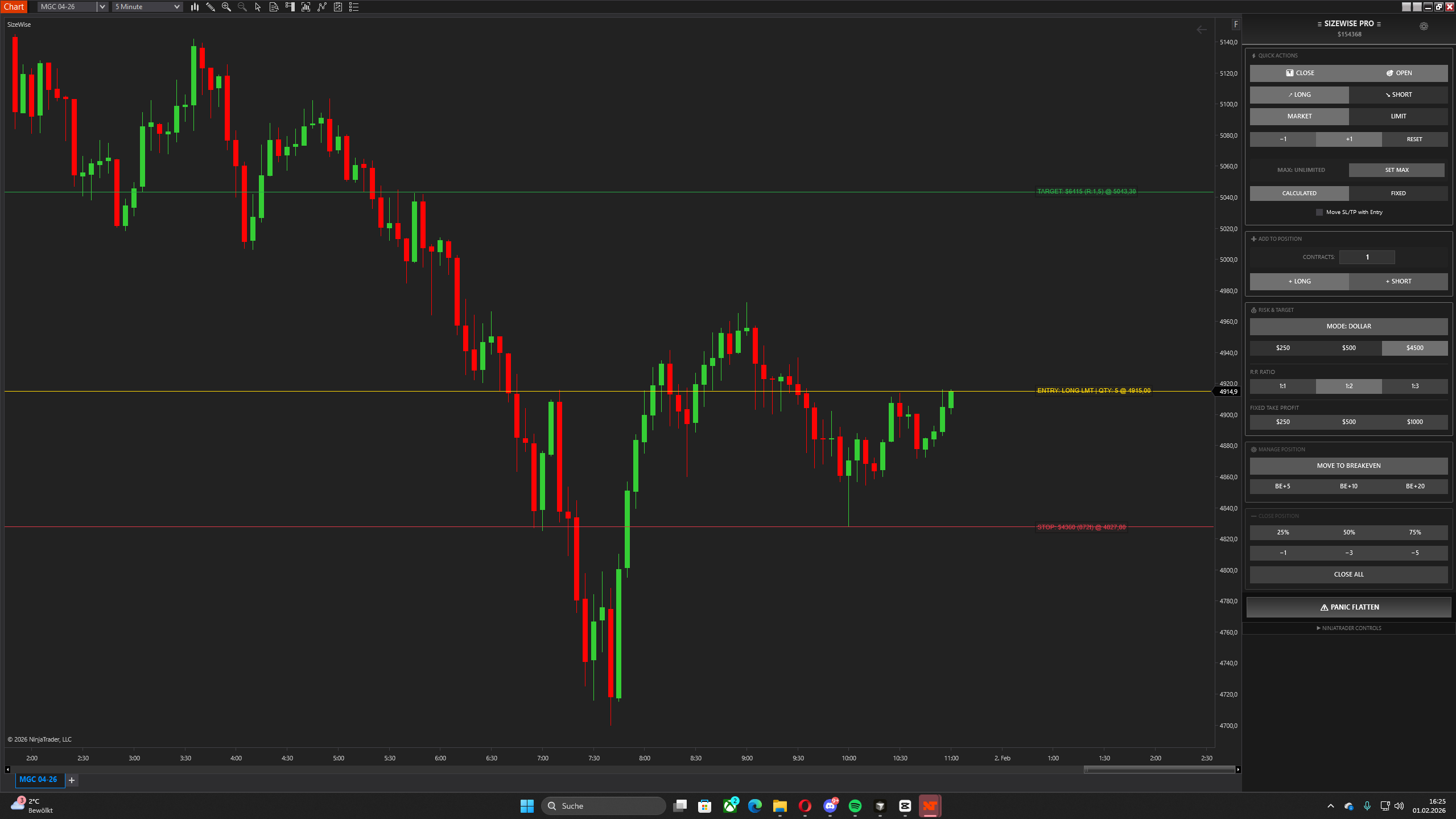
SizeWise PRO in action: The right panel shows all position sizing controls including risk modes, R:R ratios, and quick trade management buttons.
The interface gives you everything at a glance:
- Quick Actions: One-click Long/Short entries with Market or Limit orders
- Risk Mode: Set your risk in dollars ($250, $500, $4500) and SizeWise calculates contracts automatically
- R:R Ratio: Pre-set 1:1, 1:2, or 1:3 risk-reward ratios
- Position Management: Move to breakeven, partial closes, and panic flatten
See SizeWise in Action
Watch how SizeWise calculates position size in real-time as you set your entry and stop levels.
No more mental math. No more looking up tick values. No more "I'll just round up because I feel good about this one."
Common Position Sizing Mistakes to Avoid
After helping thousands of traders with their risk management, here are the mistakes we see most often:
1. Using Margin as a Sizing Guide
Just because your broker lets you trade 5 contracts doesn't mean you should. Margin requirements are about broker protection, not your risk management.
2. Rounding Up "Just This Once"
The math says 1.6 contracts, but you trade 2 because "this setup looks really good." Multiply that across hundreds of trades and you've significantly increased your risk.
3. Different Rules for Different Days
Some traders risk 1% on regular days but 3% after a losing streak to "make it back faster." This is exactly backwards. After losses, you should be more conservative, not less.
4. Ignoring Contract Specifications
Every futures contract is different. Using ES tick values for NQ calculations means your risk is completely wrong.
5. Not Accounting for Slippage
In fast markets, your stop might fill 2-3 ticks worse than expected. Build in a small buffer, especially for volatile contracts like CL.
Summary: Your Position Sizing Checklist
Before every trade, run through this checklist:
- Know your risk percentage - 1% for new traders, up to 2% for experienced traders
- Calculate dollar risk - Account × Risk % = Dollar Risk
- Measure stop distance in ticks - Entry minus Stop, divided by tick size
- Look up the correct tick value - Every contract is different
- Apply the formula - Dollar Risk ÷ (Ticks × Tick Value) = Contracts
- Round down - Never round up to stay within your risk
Or skip all that and let SizeWise do it automatically.
Position sizing won't make your setups better. It won't improve your entries or exits. But it will ensure that no single trade can destroy your account. And that's what keeps you in the game long enough to actually become profitable.
Stop Calculating. Start Trading.
SizeWise automatically calculates your position size for any futures contract. One-time purchase, lifetime updates, instant results.
Get SizeWise - $79 Lifetime